Kawa & Zahhak: The Myth That Became History
The myth of Kawa the Blacksmith (Kaveh Ahangar in Persian) and the tyrant Zahhak (Dehak/Zohhak) is the foundational narrative of Kurdish cultural identity. It is older than any Kurdish state, older than written Kurdish literature, possibly older than the Kurdish language itself in its current form. It is the story that Kurds tell about themselves when they want to explain what kind of people they are.
The Blacksmith Who Freed the World
Zahhak was a king corrupted by evil. The devil Iblis (in the Islamic version of the myth) kissed him on both shoulders, and from each shoulder grew a serpent. The serpents could only be pacified with the daily feeding of a young man's brain. The court physician devised a half-measure: feed the serpents one human brain mixed with sheep's brain, and spare one young man each day. But thousands still died.
Kawa was a blacksmith whose children were among those taken. Where others submitted, Kawa organised. He gathered the families of the condemned, hid the survivors in the mountains, and in secret forged weapons from his blacksmith's tools. On the first day of spring, he led his army to Zahhak's fortress, stormed the gates, and killed the tyrant with his leather apron used as a battle standard. This is the origin, according to Kurdish tradition, of the kaviani (royal standard) of Iranian kingship.
Kawa then climbed the mountain and lit a great bonfire to signal the liberation. Every year since, on the first day of spring, Kurds have relit those fires. The blacksmith is not a king, not a priest, not a general. He is a craftsman. This is part of the myth's meaning: liberation comes not from above but from the forge.
 Mid-17th-century Safavid miniature — Public Domain
The Myth in Kurdish History
The Kawa myth has been remarkably plastic, adapted to every era of Kurdish political struggle. In the Ottoman period, Zahhak was the sultan who demanded Kurdish children as soldiers; in the Ba'athist period, he was Saddam Hussein ordering the Anfal; in the Turkish Republican period, he was the state that banned the Kurdish language. The myth's power is its generality: it describes a structure of oppression and resistance that can be filled with any historical content.
Kurdish political movements of the 20th century consciously deployed the Kawa myth. The PKK's armed wing was named the "People's Defence Forces" (HPG) but its founding narrative draws on the blacksmith imagery. Kurdish flags, murals, and public art across the diaspora show Kawa raising his apron-standard. The bearded blacksmith with fire in his hands is the Kurdish version of the universal image of the revolutionary artisan.
Kawa in Literature
The myth appears in its earliest written form in the Shahnameh of Ferdowsi (completed 1010 CE) – the Persian national epic in which Kawa (spelled Kaveh) appears as a blacksmith of the Iranian-Kurdish highlands. But the Kurdish version of the story differs from Ferdowsi's in important ways: in the Kurdish telling, it is explicitly the Kurdish mountains that the survivors flee to; it is Kurdish craftsmen who forge the weapons; and the bonfire on the mountain peak is specifically associated with Newroz.
Ahmad Khanî's Mem û Zîn (1692) references the Kawa myth obliquely in its political preface; 20th-century Kurdish poets from Cegerxwîn to Sherko Bekas have written directly about it. The myth has also entered Kurdish children's literature, comic books, and – in the diaspora – graphic novels and animated shorts that carry it to generations who no longer speak Kurdish as a first language.
The Simurgh – Bird of All Wisdom
The Simurgh (Sîmurg in Kurdish, Sīmurgh in Persian) is the great mythological bird of the Iranian-Kurdish tradition. It is ancient beyond reckoning, vast beyond comprehension, nesting in the tree of all knowledge, and knowing all things that have ever happened. It is simultaneously the most magnificent creature in the world and the most accessible: it hatches the hero Zal from the egg of his abandonment, raises him in its nest, and gives him three feathers that summon it in times of need.
 Zal Rescued by the Simurgh — Public Domain
Zal and the Simurgh
The hero Zal was born white-haired – considered an evil omen – and abandoned by his father Sam on a mountainside. The Simurgh found the infant, took pity on him, and raised him in its mountain nest as one of its own children. When Zal's father finally sought to reclaim his son, the Simurgh willingly returned him to the human world, but gave him three feathers from its own body. "Burn one," it told him, "when your need is greatest, and I will come."
Zal used the feathers at three critical moments: to save his wife Rudabeh in a dangerous childbirth (the Simurgh performed the first Caesarean section in mythology); to heal his son Rustam from battle wounds; and to save the Iranian kingdom from catastrophe. The feather stories encode a theology of divine help: the divine does not intervene without being called; the call must be specific and the need genuine; but when called, the divine answers without fail.
In Kurdish folk tradition, the Simurgh often loses its literary grandeur and becomes more intimate: a magical bird encountered by lost travellers, speaking in riddles, offering three gifts or three questions, testing the hero's wisdom rather than his courage. The test is always moral: the Simurgh does not help those who approach it with pride, greed, or deception.
The Thirty Birds
In Farid ud-Din Attar's 12th-century Sufi masterpiece Conference of the Birds (Manteq al-Tayr), the birds of the world set out to find the Simurgh, their king. After an epic journey through seven valleys, only thirty birds survive. When they finally reach the Simurgh's dwelling, they realise that the word "Simurgh" in Persian means "thirty birds" (si = thirty, murgh = bird). The seeker and the sought are the same. This Sufi interpretation of the Simurgh myth – common currency in Kurdish Sufi circles – is one of the most elegant theological paradoxes in any mystical tradition.
The Kurdish Heroic Imagination
Kurdish oral and written literature contains several distinct heroic cycles. Some are shared with the broader Iranian cultural tradition (Rustam, the Zal cycle), some are specifically Kurdish (Mem û Zîn, the dengbêj epics of resistance), and some bridge the two (the Dimdim cycle, the story of the Kurdish prince who held a fortress against the Safavid emperor for three years rather than submit). Together they constitute a heroic imagination of considerable depth.
 Baysanghar Shahnameh — Public Domain
Rustam Zal: The Invincible Hero
The greatest hero of the Iranian-Kurdish tradition. He is the son of the white-haired Zal and Rudabeh, invincible in battle but not in fate. Rustam's Seven Labours (Haft Khan) see him battle lions, demons, dragons, sorcerers, and finally the White Demon himself, whose liver blood alone can restore the sight of the blinded king.
His deepest tragedy is not battle but recognition: the accidental killing of his own son Sohrab. This is a story of fathers and sons who fight before knowing each other, retold in Kurdish epic song for a thousand years as the defining image of fate's cruelty.

Mem û Zîn
مەم û زینThe Romeo and Juliet of Kurdish literature: a folktale of the Cizre region in which two lovers are separated by a treacherous intermediary (Bekir) and die of heartbreak. Ahmad Khanî's 1692 epic poem is the literary version, but the folk story predates it by centuries. In the folk version, two trees grow from their graves and intertwine above the stone that separates them, the stone of Bekir's malice finally split by their roots.
Kurmanji · Love Epic · Folk
Dimdim Castle
دمدمThe epic of the Kurdish prince Khanamir who held Dimdim Castle in the Lake Urmia region against the Safavid Shah Abbas I for three years (c. 1609–1610). When the castle fell, the entire Kurdish population was massacred or deported. The siege of Dimdim became the central Kurdish resistance epic. It is the story of defiant dignity in the face of overwhelming force, retold in countless Kurmanji and Soranî epic songs for four hundred years.
Resistance · Safavid Era
Shahmaran: The Queen of Serpents
شاهمەرانShahmaran (Shah + Maran = "King/Queen of Serpents") is a mythological figure unique to the Kurdish and southeastern Anatolian tradition. She is a beautiful woman from the waist up, a serpent below, who lives in an underground kingdom of snakes and possesses all human and natural knowledge. Discovered by a honey gatherer, she teaches him everything; betrayed to the king, she is killed and her flesh eaten by those seeking immortality. Her image decorates tiles, textiles, and buildings across Kurdish areas of Turkey.
Kurdish Anatolia · Snake Queen
Dewrêşê Evdî: The Warrior-Lover
دهورێشێ عهودیOne of the most celebrated and heartbreaking tragic epics of Kurmanji oral literature. Dewrêşê Evdî was a valiant Yazidi warrior who fell profoundly in love with Edûlê, a Muslim Kurdish woman of another tribe. When her father's tribe came under attack, Dewrêş rode to their defence, not out of obligation but out of love. He died a heroic death in battle, his story becoming the archetype of the warrior-lover who crosses religious and tribal boundaries for honour and devotion. His kilam (epic song), performed by dengbêj masters, is one of the most emotionally devastating in the repertoire. It is a Kurmanji equivalent of Tristan and Iseult, carrying within it the tragedy of inter-communal love in a divided highland world.
Kurmanji Epic · Tragic Hero · Yazidi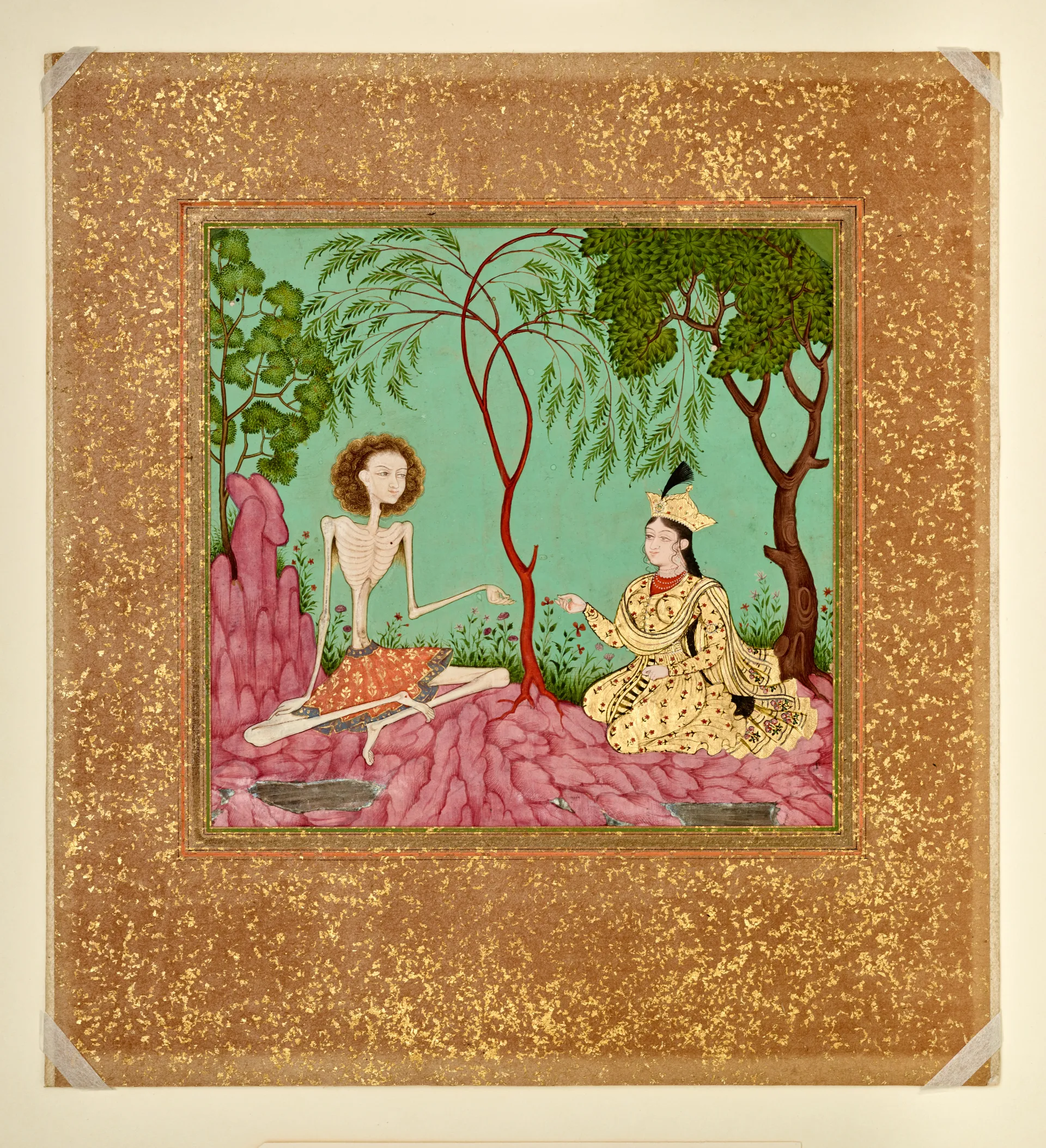
Leyla û Meclûn
لهیلا و مهجنونThe Kurdish version of the Layla and Majnun love cycle. The Arabic story of the poet driven mad by love was adapted into Kurmanji and Soranî narrative tradition with distinctively Kurdish settings, imagery, and emotional register. The mad lover wandering the mountains, composing verse to an inaccessible beloved, is a recurring figure in Kurdish classical poetry; the Leyla û Meclûn cycle provided the template. Countless classical Kurdish poets wrote their own versions.
Love Cycle · Classical · Pan-KurdishThe Invisible World – Kurdish Spirit Lore
The Kurdish folk supernatural is a densely populated world. Spirits inhabit springs, trees, mountain passes, and thresholds; creatures of ambiguous moral character occupy the wilderness between villages; and the boundary between the living and the dead is permeable in ways that require constant ritual management. This spirit world is not "superstition" to be contrasted with "real" religion. It is the practical cosmology of mountain people who understood their dangerous environment through narrative.
Perî: The Spirit People
Perî (fairies, from the Persian pari) are the most prominent supernatural beings in Kurdish folk tradition. They are beautiful, capricious, and potentially dangerous inhabitants of the wild world who interact with humans at springs, mountain passes, and liminal hours (midnight, noon, the transition between seasons). They are not simply "good" or "evil" – they respond to how humans treat them.
A spring with a resident perî must be approached with respect: no urinating nearby, no throwing rubbish, no approaching in a state of ritual impurity. Those who offend a perî suffer illness, madness, or loss; those who treat the perî well may receive gifts of luck, beauty, or healing knowledge. Female perî are most common in the stories; they sometimes fall in love with human men and the affairs end badly for everyone.
Div: Giants & Demons
Div (from the Avestan daeva, related to Sanskrit deva) are the great supernatural antagonists of Kurdish folk tradition: massive, often stupid, sometimes malevolent beings who inhabit caves, mountain tops, and wastelands. Unlike the perî, div are consistently threatening. The task of the folk hero is always to outwit or kill the div through cunning rather than strength.
The Kurdish div is related to but distinct from the Islamic djinn: it pre-dates Islam and carries traces of the Zoroastrian cosmological conflict between ahura (divine forces) and daeva (forces of chaos). In folk stories, the div often has a specific weakness: a hidden external soul, a vulnerable heel, a single hair that must be pulled. The hero always discovers it.
Cin û Ruh: Jinn and Ghosts
Islamic folk belief has overlaid the pre-Islamic spirit world with the Quranic category of jinn: beings made of smokeless fire who inhabit the same world as humans but in a parallel register. Kurdish folk Islam has thoroughly integrated the jinn tradition, producing a complex hierarchy of supernatural beings ranging from the relatively harmless (minor household jinn who steal things) to the dangerous (the qarin, a personal spirit double that can possess its human counterpart).
The ghost tradition (ruh, soul) in Kurdish folk belief holds that the dead whose business is unfinished – who died unavenged, or far from home, or without proper burial – linger near the places of their death until the obligation is fulfilled. Dengbêj performance traditionally served a quasi-ritual function here: singing the names and stories of the dead in public was believed to give their souls permission to depart.

Çav Reş: The Evil Eye
چاو ڕەشBelief in the evil eye (çav reş, "black eye") is universal across Kurdish communities and practiced regardless of religious affiliation. Beautiful children, healthy livestock, and new possessions are vulnerable to involuntary harmful attention from those with "strong eyes." Protection involves blue beads (nazar boncuğu), burning rue (espand), and specific spoken formulas. Cures involve incantation by a knowledgeable elder woman, often involving thread, salt, or coal.
Folk Belief · Universal
Kaniya Pîroz: Sacred Springs
کانیا پیرۆزSacred springs (kaniya pîroz) are found across the Kurdish landscape, each with its resident spirit, its healing properties, and its ritual requirements. Pilgrims tie fabric strips to the tree above the spring as petitions; offerings of food, money, or animal sacrifice may be left; bathing in the spring on specific days cures specific ailments. Many of these springs have been sacred since pre-Islamic times and represent the most durable element of indigenous Kurdish sacred geography.
Nature Spirit · Healing · Pre-Islamic
Pîra Alê: The Night Hag
پیرا ئاڵێA female supernatural being of the night. She is a hag who attacks women in childbirth and new mothers, stealing their liver and causing puerperal fever. Pîra Alê (the al woman) is the most feared of Kurdish domestic supernatural threats. Elaborate rituals surround childbirth specifically to ward her away: iron placed under the mattress (she cannot cross iron), specific prayers recited by the midwife, candles kept burning. Her presence in Kurdish folk belief predates Islam and is cognate with similar beings across the Iranian world.
Birth Spirit · Protection RitualThe World of Tawusi Melek
The Yazidi religious tradition contains one of the most distinctive cosmologies of any faith. It is a creation myth and theology that incorporates elements of ancient Iranian religion, Gnostic Christianity, Islamic Sufism, and an indigenous Kurdish spirituality that appears to pre-date all of them. The Yazidi creation story is not mythology in the dismissive sense; it is a living theology, still practiced by hundreds of thousands of people and threatened by genocidal violence in our own time.
Tawusi Melek: The Peacock Angel
At the centre of Yazidi theology is Tawusi Melek: the Peacock Angel, the most important of God's seven emanations (angels), who was tasked by God with the care of the earth. When God commanded all the angels to bow before Adam, Tawusi Melek refused, not out of disobedience but because he could not bow to any being other than God himself. God recognised this as the most pure form of monotheism and elevated Tawusi Melek above all other angels, entrusting him with the governance of the world.
Non-Yazidi observers have mistakenly identified Tawusi Melek with Satan (the angel who refused to bow to Adam in the Quran) and accused the Yazidis of devil worship. This is a slander that has fuelled persecution for centuries and provided ISIS's justification for the 2014 genocide. The identification is theologically illiterate: Tawusi Melek's refusal is the opposite of Satanic pride; it is the refusal to commit what Yazidis consider the greater sin of false worship.
The Creation Myth
In the beginning, God existed alone. He then created a pearl, and from that pearl a bird (some versions say Tawusi Melek himself). The bird's wings spread across the void; from the world-egg the universe was born. God created seven angels from his own light, Tawusi Melek first among them, and tasked them with the care of creation. The sun is God's most visible emanation; Wednesday (Çarşema Sor's day) is sacred because it was on Wednesday that the world was completed.
The Yazidi soul is immortal and transmigrates between bodies. This belief is called "changing the garment" (kiras guhorîn) rather than reincarnation, since the soul remains essentially the same while its bodily form changes. Righteous souls ascend gradually toward the divine light; souls that accumulate wrong actions must repeat the human experience until they are purified. The concept has more in common with ancient Iranian soul-doctrine than with any of the Abrahamic religions, and may represent the oldest stratum of Yazidi belief.
Kurdish Proverbs – The Living Philosophy
Kurdish proverbs (gotinên pêşiyan – "the sayings of the ancestors") are the most widely distributed form of Kurdish folk literature. They are carried in every dialect, memorised by every generation, and deployed in conversation as both argument and aesthetic. They encode the mountain people's accumulated wisdom about hospitality, honour, patience, fate, and the proper relationship between humans and the natural and divine worlds.
"Gotinên pêşiyan têxin bin ziman, nedana bin lingê çê."\n"Put the sayings of the ancestors under your tongue, not under your foot."— – Kurdish proverb about the proper use of traditional wisdom