Travelling the Kurdish Lands
Kurdistan spans four countries – Iraq, Turkey, Iran, and Syria – each with different entry requirements, infrastructure, and accessibility for visitors. The most developed and easiest to visit is the Kurdistan Region of Iraq (Başûr), which has international airports, a growing hotel industry, and a population that is extraordinarily welcoming to foreign visitors. This guide covers all four regions with honest practical advice.
Başûr: Iraqi Kurdistan
باشوری کوردستانMost accessible. Erbil and Sulaymaniyah have international airports. Visa on arrival for most nationalities. Best infrastructure, most sites open to visitors.
Bakur: Turkish Kurdistan
باکوری کوردستانAccessible via Turkey. Security situation varies by area. UNESCO sites in Diyarbakır, Nemrut. Check travel advisories before visiting southeastern Turkey.
Rojhilat: Iranian Kurdistan
ڕۆژهەڵاتی کوردستانAccessible via Iran visa. Kurdish mountain landscapes of great beauty. Travel restrictions in border zones. Infrastructure less developed for tourism.
Rojava: Syrian Kurdistan
ڕۆژاوای کوردستانCurrently not recommended for tourism due to ongoing conflict and political instability. Monitor situation carefully. Rich cultural sites inaccessible at present.
Essential Travel Information
- Best time to visit Iraqi Kurdistan: April–June and September–November. Summers are hot (40°C+); winters can close mountain roads
- Erbil airport (IATA: EBL) has direct flights from European cities including Vienna, Frankfurt, Amsterdam, and London
- Sulaymaniyah airport (IATA: ISU) offers connections via Dubai, Beirut, and Istanbul
- Currency: Iraqi Dinar (IQD) in Başûr; US dollars widely accepted. Turkish Lira in Bakur
- Language: Soranî in Başûr; Kurmanji in Bakur and Rojava. English widely spoken in Erbil/Slemani hotels and tourist sites
- Safety (Başûr): Kurdistan Region of Iraq has not experienced the violence affecting the rest of Iraq. Generally safe for tourists
Kurdish Hospitality: Mêvandarî
- Kurdish hospitality (mêvandarî) is among the most celebrated in the world. Guests are treated as honoured visitors regardless of origin
- If invited to a home, expect tea (çay), fruit, and almost certainly a full meal. Refusing food is impolite
- Dress modestly outside cities and at religious sites. Women should cover hair at mosques and Yazidi temples (scarves available at Lalish)
- Photography: always ask before photographing people. Most Kurds are happy to be photographed; military and government buildings are sensitive
- Newroz (21 March) is the best time to experience Kurdish cultural life. The entire population is in the streets, mountains, and parks celebrating
- Bargaining is expected in bazaars; fixed prices in shops. Start at 50–60% of the asking price in markets
Stones of Deep Time
The Kurdish highlands are among the oldest continuously inhabited regions on earth. Archaeological sites in Iraqi Kurdistan have pushed back the origins of human settlement to 12,000 BCE and beyond; the citadel of Erbil has been occupied without interruption for at least 6,000 years; cave paintings, Neanderthal burials, and Bronze Age fortresses cover a landscape whose archaeological potential has barely been touched.
Erbil Citadel: The Oldest City
The Citadel of Erbil (Qelay Hewlêr) rises 32 metres above the surrounding plain on an artificial mound – a tell – built by 6,000 years of continuous human occupation. Each generation built on the ruins of the last, layer by layer, until the mound itself became the most striking urban landmark in Iraqi Kurdistan. UNESCO inscribed it as a World Heritage Site in 2014.
The current structure dates largely from the Islamic period (10th–19th century), but the tell beneath it contains Bronze Age, Assyrian, and Parthian layers yet to be fully excavated. The citadel's gates, covered bazaars, and restored traditional houses are now open to visitors; the surrounding old city – with its textile traders, gold markets, and tea houses – is one of the great urban experiences of the Middle East.

 Heritage
Başûr
Heritage
Başûr
Shanidar Cave
شانیدارThe cave where ten Neanderthal skeletons were excavated (1957–1961), including evidence of intentional burial with flowers – suggesting ritual burial practices 60,000 years ago. One of the most significant archaeological discoveries of the 20th century, in the Barzan valley of Iraqi Kurdistan. New excavations since 2015 have found additional remains.
 Heritage
Başûr
Heritage
Başûr
Amadiya (Amêdî)
ئامێدیA walled hilltop city perched on a flat-topped rock at 1,400 metres – inhabited since the Assyrian period and serving as capital of a Kurdish principality through the medieval era. The town's single road winds up through a carved rock gate; the plateau above holds a mosque, a 16th-century minaret, and views across mountain valleys in every direction. One of Iraq's most dramatically situated settlements.
 Heritage
Bakur
Heritage
Bakur
İshak Paşa Palace
ئیسهاق پاشا سراییAn 18th-century palace-complex near Doğubayazıt in eastern Turkey. It is the most spectacular example of late Ottoman Kurdish palatial architecture, combining Ottoman, Persian, Armenian, and Georgian architectural elements in a building of extraordinary visual richness. Perched above the Aras valley with Mount Ararat visible on clear days, it was built by the Çıldıroğulları Kurdish dynasty over roughly 99 years (1685–1784).
 Heritage
Bakur
Heritage
Bakur
Hasankeyf
حسنکێفA 12,000-year-old settlement carved into limestone cliffs above the Tigris river. It is one of the oldest continuously inhabited sites on earth, partially flooded since 2020 by the Ilısu Dam despite international protest. The lower town is now under water; the cliff caves, medieval minaret, and Ayyubid-era mosque remain above the waterline. A world heritage site of immense significance, lost to modernity. Visit while the upper sections remain accessible.
 Heritage · UNESCO
Bakur
Heritage · UNESCO
Bakur
Diyarbakır / Amed City Walls
ئامەد — سورا AmedThe UNESCO World Heritage-listed basalt city walls of Diyarbakır: five kilometres of black volcanic stone walls up to 12 metres high, built by the Romans and expanded by successive Islamic dynasties including the Marwanid Kurdish dynasty (990–1096 CE). The city they enclose, known to Kurds as Amed, is the historical cultural capital of Bakur Kurdistan. Its bazaars, mosques, and courtyards remain little changed since the medieval period.
 Heritage · UNESCO
Rojhilat
Heritage · UNESCO
Rojhilat
Behistun (Bisotun) Inscription
بیسوتونThe rock relief of Darius I carved into a 1,200-metre cliff face above the ancient Silk Road in Iranian Kurdistan. It is the Rosetta Stone of cuneiform writing, inscribed in three languages (Old Persian, Elamite, Babylonian) and instrumental in deciphering the entire cuneiform script. The surrounding mountain is legendary in Kurdish folklore as the site where the stone-carver Farhad carved the cliffs out of his love for Princess Shirin.
The Kurdish Mountain World
The geography of Kurdistan is one of the most dramatic in the Middle East: from the perpetual snowfields of the Zagros to gorges that drop hundreds of metres to turquoise rivers, from alpine meadows carpeted with spring flowers to desert plateaus with views extending to three countries. Kurdistan's natural landscape is largely unknown to international tourism and represents one of the great undiscovered travel experiences of the region.
 Nature
Başûr
Nature
Başûr
Rawanduz Canyon / Hamilton Road
دەربەندی ڕەوەندزThe most spectacular road in Iraqi Kurdistan. It was carved into sheer cliff walls above a turquoise gorge by New Zealand engineer Archibald Hamilton in the 1920s–30s (originally for military access). The canyon plunges 300+ metres; the road clings to its edge; the Rawanduz river threads the valley below. Often called the "Switzerland of Iraq" – a description that undersells its savage grandeur.
 Nature
Başûr
Nature
Başûr
Geli Ali Beg Waterfall
گەلی عەلی بەگThe most visited natural site in the Kurdistan Region: a 40-metre waterfall above a canyon pool, at the entrance to the Rawanduz gorge. Surrounded by tea houses, restaurants, and picnic areas used by Kurdish families throughout the summer. In spring, the falls run at full force and the canyon walls bloom with wildflowers. The name honours a Kurdish chieftain who once controlled this mountain pass.
 Nature
Başûr
Nature
Başûr
Choman Valley
چومانA high mountain valley near the Iranian border: alpine meadows at 1,700 metres, snow-capped peaks, herds of sheep and cattle driven by nomadic Kurdish pastoralists in the summer months. The valley floor is carpeted with wildflowers in May and June. The surrounding peaks rise to over 3,600 metres; the Halgurd Mountain (3,607m) is the highest peak in Iraqi Kurdistan and attracts trekkers from across the region.
 Nature
Başûr
Nature
Başûr
Dukan Lake
دەریاچەی دوکانThe largest lake in the Kurdistan Region. It is a turquoise reservoir formed by the 1959 Dukan Dam on the Little Zab river, surrounded by pale limestone cliffs and used as a water sports and leisure destination by residents of Sulaymaniyah (70km southeast). Boat trips, swimming, and lakeside restaurants make it the most popular recreational destination in Başûr. The surrounding terrain includes dramatic rock formations above the water line.
 Nature
Başûr
Nature
Başûr
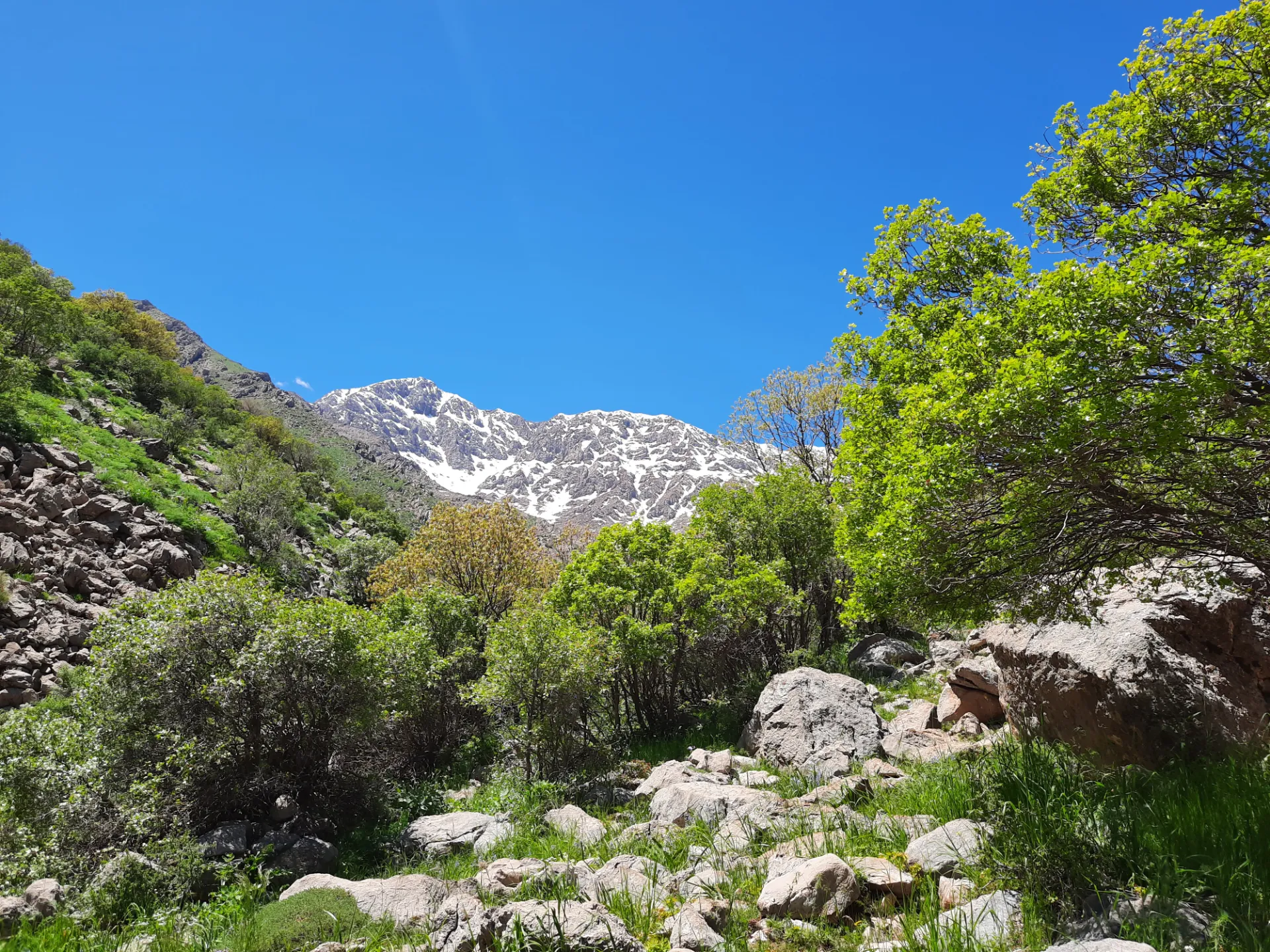
Barzan Valley
بارزانThe ancestral homeland of the Barzani dynasty. It is a remote mountain valley above the Greater Zab river whose dramatic geography shaped the character of the Kurdish national movement. The valley's near-inaccessibility made it a refuge across centuries; the Barzani tribe's control of these mountain passes gave Mustafa Barzani's insurgency its strategic base. The valley today is a pilgrimage site for Iraqi Kurds and contains the tomb of Mustafa Barzani.
 Nature
Rojhilat
Nature
Rojhilat
Shaho Peak
چیای شاهوAt 3,360 metres, the highest accessible mountain in Iranian Kurdistan. It is a Zagros ridge peak overlooking the Kermanshah-Sulaymaniyah border with views across both countries on clear days. The mountain is sacred in Kurdish tradition; its slopes are habitat for wild goat, bear, and leopard. Kurdish mountaineering clubs from both Iranian and Iraqi Kurdistan use Shaho as a training peak. The approach through Paveh is itself a journey through Kurdish mountain culture.
Temples, Shrines & Holy Ground
Kurdistan holds sacred sites of extraordinary antiquity and diversity: from the holiest temple of the Yazidi faith (a religion older than Islam and Christianity) to 4th-century Syriac Christian monasteries, from Sufi shrines deep in mountain valleys to the Alevi sacred sites of Dêrsim. Religious diversity is one of Kurdistan's defining cultural characteristics.
 Sacred · Yazidi
Başûr
Sacred · Yazidi
Başûr
Lalish Temple
لالشThe holiest site in the Yazidi religion. It is a temple complex in a mountain valley north of Duhok that has been sacred to the Yazidis for at least 4,000 years and has served as the centre of Yazidi religious life for centuries. The fluted conical spires of the shrine of Sheikh Adi ibn Musafir (12th century) are the most recognisable images of Yazidi sacred architecture. All Yazidis are required to make a pilgrimage to Lalish at least once in their lifetime.
 Sacred · Christian
Bakur
Sacred · Christian
Bakur
Deyrulzafaran Monastery
دیرولزعفرانThe "Saffron Monastery" – a 4th-century Syriac Orthodox monastery near Mardin that served as the seat of the Syriac Orthodox patriarchate for 1,000 years (640–1932). One of the oldest continuously functioning Christian monasteries in the world, its golden stone walls, carved chapels, and ancient crypt contain 2,000 years of Syriac Christian heritage. The surrounding landscape — terraced valleys above the Mesopotamian plain — is haunting in its beauty.
 Sacred · Alevi
Bakur
Sacred · Alevi
Bakur
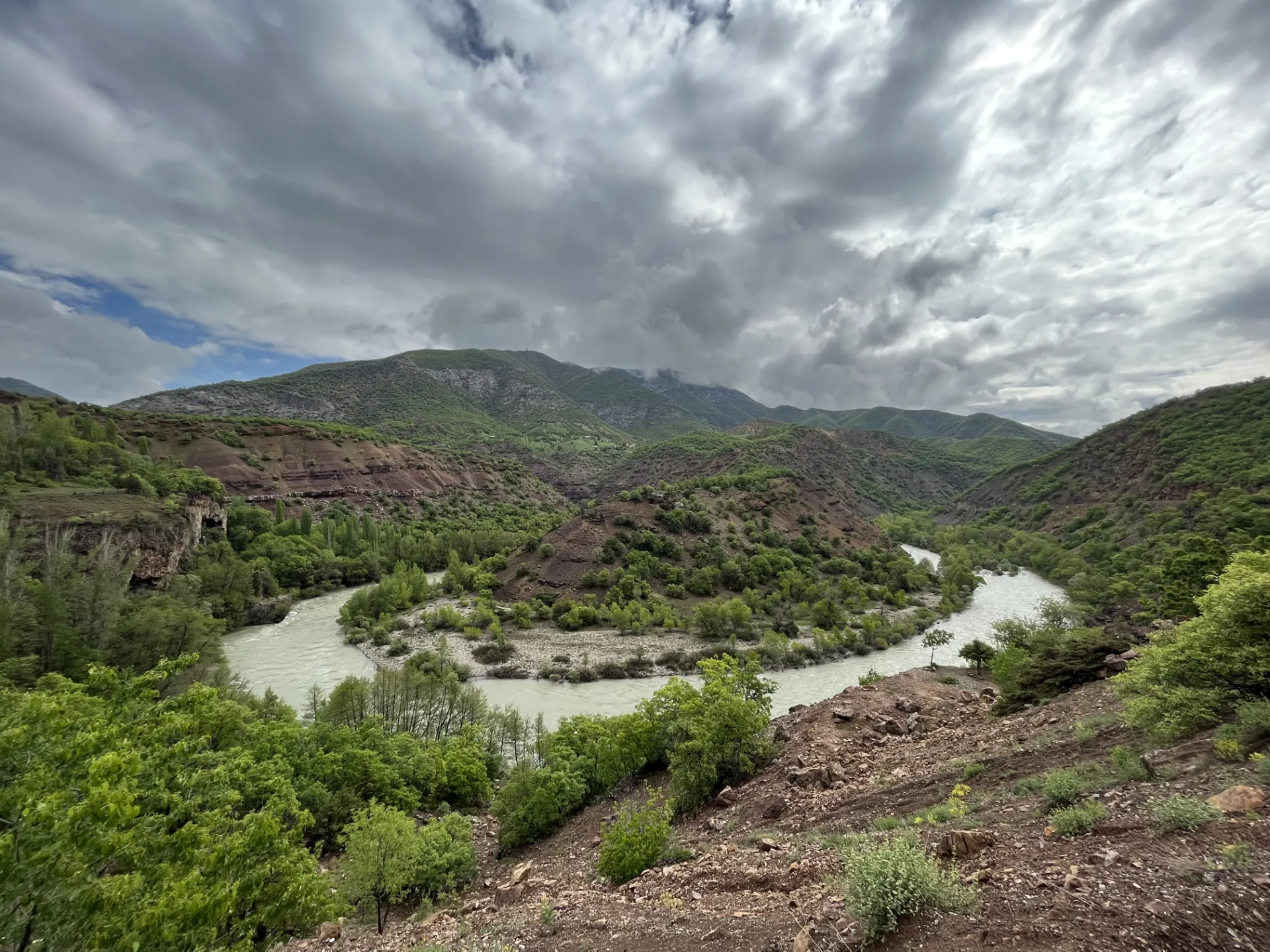
Munzur Valley, Dêrsim
دێرسم · DêrsimThe mountain heartland of the Alevi Kurdish (Kızılbaş) tradition. The Munzur valley in Tunceli province is one of the most sacred landscapes in Alevi religion, where springs, trees, and mountain peaks are understood as manifestations of the divine. The valley was the site of the 1937–38 Dêrsim massacre in which the Turkish army killed thousands of Alevi Kurds. It remains a site of pilgrimage, mourning, and extraordinary natural beauty simultaneously.
Remembering What Must Not Be Forgotten
Kurdish history is not only a history of beauty and achievement. It is also a history of atrocity, and the sites of that atrocity are part of the heritage landscape. The Halabja Memorial and the Anfal documentation sites are not tourist attractions in any conventional sense; they are sites of witness, where visitors are asked to understand what happened and why it matters.

"To visit Halabja is not tourism. It is bearing witness — the most important thing a visitor can do for a people whose suffering was ignored by the world when it happened."– Kurdish cultural writer
Other Memorial Sites
- Anfal Memorial, Sulaymaniyah – documents the 1986–1989 Anfal campaign in which 182,000 Kurds were killed or disappeared
- Amna Suraka (Red Security) Museum, Sulaymaniyah – the former Ba'ath Party intelligence headquarters turned into a museum of the Kurdish genocide experience
- Qazi Muhammad's execution site, Mahabad – where the president of the Kurdish Republic was publicly hanged in 1947
- Dêrsim massacre sites, Tunceli – the 1937–38 Turkish army campaign against Alevi Kurds, only officially acknowledged as a massacre in 2011
What to Do and See
The Kurdistan Region of Iraq has invested heavily in tourism infrastructure over the past decade: ski resorts, cable cars, rafting operations, and trekking routes have opened a landscape of extraordinary variety to visitors. Beyond the organised attractions, the richest experiences are often the simplest: a family picnic by a mountain spring, a seat in a Sulaymaniyah tea house, an evening in Erbil's old bazaar.
 Tourism
Başûr
Tourism
Başûr
Korek Mountain Resort
کۆرەکKurdistan's premier mountain resort: a cable car ascending 1,350 metres from the valley floor to a summit plateau at 2,127 metres, with hotels, restaurants, and winter skiing. The cable car itself offers views across the Rawanduz canyon system that are among the most dramatic in Iraq. In summer the plateau is cool and green; in winter it holds reliable snow for skiing and snowboarding. The most developed tourist infrastructure in the Kurdistan Region.
 Culture
Başûr
Culture
Başûr
Sulaymaniyah Bazaar: Mawlawi Street
بازاڕی سلێمانیThe cultural heart of Sulaymaniyah: a traditional covered bazaar selling Kurdish textiles, silver jewellery, copperware, spices, and the city's legendary sweets. The surrounding tea houses are frequented by poets, intellectuals, and students in a city that has always valued literary culture. The Sulaymaniyah Museum, one of Iraq's finest archaeological collections, is five minutes' walk from the bazaar. An afternoon here is the best introduction to Kurdish urban life.
 Culture
Başûr
Culture
Başûr
Akre Old Town
عەقرێOne of the best-preserved traditional Kurdish townscapes: a hillside town of stone houses, stepped alleys, and medieval-era architecture in Duhok governorate. Akre's old quarter climbs the cliff face above the modern town in a vertiginous cascade of stone; its New Year (Newroz) celebrations are famous across Kurdistan, when the hillside is lit with bonfires. The town's population is predominantly Yazidi and Shabak alongside Muslim Kurds.
 Heritage · Tourism
Başûr
Heritage · Tourism
Başûr
Pira Delal: Zakho Old Bridge
پرا دلال — Pira Delal"The beautiful bridge" – an Abbasid-era stone arch bridge over the Khabur river at Zakho, one of the most photographed monuments in Iraqi Kurdistan and a UNESCO nomination candidate. Its single graceful arch spans the clear mountain river at the gateway town to Kurdistan from Turkey. The surrounding old town quarter retains traditional stone architecture; the region around Zakho (the Badinan) has a distinctive dialect, culture, and mountain landscape.
 Nature · Tourism
Başûr
Nature · Tourism
Başûr
Penjween
پێنجوێنA mountain town near the Iranian border celebrated for its forests, waterfalls, and cool summer climate – "the green of Sulaymaniyah." The surrounding Qandil mountain range and valleys are some of the most ecologically rich in Iraq, with oak forests, walnut groves, and mountain streams. Kurdish families from across the south drive to Penjween in summer to escape the heat; camping, hiking, and picnicking infrastructure has developed rapidly in recent years.
 Culture · City
Başûr
Culture · City
Başûr
Erbil Old City & Bazaar
بازاڕی هەولێرThe bazaars surrounding the Erbil Citadel are among the most atmospheric in Iraq: the textile market (Qaysari), the gold bazaar, the spice market, and the coppersmith quarter all operate as they have for centuries, in covered lanes that channel cool air from the citadel's massive walls. The surrounding new city of Erbil is home to excellent Kurdish restaurants, coffee shops, and the best hotels in the Kurdistan Region.
How to Travel Kurdistan
Practical guidance for visiting the Kurdistan Region of Iraq – the most accessible and tourist-ready part of Kurdistan. For other regions, consult current travel advisories from your government.
Visas & Entry
Most nationalities receive a visa on arrival at Erbil or Sulaymaniyah airports. No advance application required. The KRI visa is separate from Iraqi federal visas. Passport valid 6+ months required. Some nationalities (Israeli, some others) may face restrictions — check in advance.
Getting There
Erbil (EBL) has direct flights from Vienna, Frankfurt, Amsterdam, Istanbul, Dubai, Doha, and many other hubs. Sulaymaniyah (ISU) connects via Dubai, Beirut, and Istanbul. Land entry from Turkey via Ibrahim Khalil / Habur crossing is efficient and well-organised.
Getting Around
Hiring a driver/guide is the most practical way to reach mountain sites. Car hire available in Erbil and Sulaymaniyah with international licence. Roads are generally good between major cities; mountain roads to remote sites require 4WD in winter. Taxis are cheap and plentiful in all cities.
Accommodation
Erbil has international hotels (Rotana, Divan, Ramada) and boutique options in the old city. Sulaymaniyah has excellent mid-range hotels. Budget options in all major towns. Mountain areas have basic chalets and camping. Book ahead for the summer peak season (July–August).
Food & Drink
Kurdish cuisine is outstanding — kebab, dolma, rice dishes, fresh bread, and extraordinary mezze. Alcohol is available in restaurants in both Erbil and Sulaymaniyah (Kurdistan Region is more liberal than federal Iraq). Bottled or filtered water is highly recommended everywhere, including in major cities and hotels. çay (tea) is offered everywhere and refusing is mildly impolite.
Safety
The Kurdistan Region of Iraq has been consistently safe for visitors throughout the post-2003 period — it did not experience the civil war and IS violence that affected central and southern Iraq. The Peshmerga security forces maintain effective control. Normal urban precautions apply. Do not approach military checkpoints without slowing down and complying with instructions.
When to Go
Spring (April–May) is the best season: wildflowers, waterfalls at full strength, pleasant temperatures 20–28°C. Autumn (Sept–Oct) is also excellent. Summer (June–Aug) is very hot in lowland cities (40°C+) but comfortable in the mountains. Winter brings snow to high areas (Dec–Feb): Korek ski season. Newroz (21 March) is the unmissable cultural event.
Language Tips
Soranî Kurdish in Başûr; English widely spoken in hotels, restaurants, and tourist sites. A few Kurdish words go a long way: "Spas" (سپاس, thank you), "Chonî?" (چۆنی?, how are you), "Başe" (باشە, good/OK). Arabic is spoken in mixed areas. French and German speakers will find English easier for navigation.
"The mountains are our only friends."– Kurdish proverb · تەنها چیاکان دۆستی کوردن